




















































(Carla Pemberton)
Black-American writer and professor Audre Lorde once said, “We are powerful because we have survived, and that is what it is all about–survival and growth.”
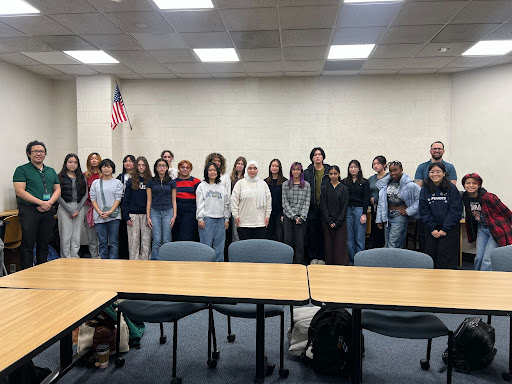
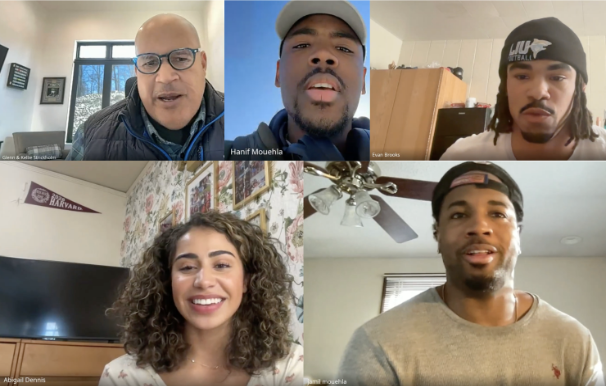
Black History Month has evolved to a 28-day celebration in February instead of a singular “Negro History Week,” as it was initially introduced in 1926. In its shift away from a sole focus on historical struggles, Black History Month now also commemorates the “survival” and “growth”—as Lorde states—of Black individuals. It highlights Black achievements and success, especially in the face of discrimination. In honor of this celebratory month, the Black History and Culture Club (BHCC) developed a Black History Month documentary. Shown on Friday, February 20, in the auditorium, it investigated the lives of several interviewees during their time at school in Northern Valley. On Tuesday, February 3, the BHCC interviewed Demarest alumni Glenn Strickholm and Old Tappan alumni Abigail Dennis, Evan Brooks, and Mouehla brothers Jamil and Hanif over a Zoom meeting.
Abigail Dennis, a 2024 graduate who runs track at Harvard University, founded the BHCC along with 2023 alumni Hanif Mouehla, who is also a current Harvard student. Dennis explained that she and H. Mouehla developed the club in hopes of “educating the Northern Valley community because this was the first club of its nature.” Because the concept had been unexplored, Dennis and H. Mouehla spent the majority of the school year making edits and proposals for the club so it could be approved by administration.
Dennis is glad to see that hers and H. Mouehla’s efforts and legacies are being carried on at the school. “I love everything that you guys are doing,” she told the club during the meeting. “I’m happy to see that the BHCC is still on and running.”
1983 Demarest alumni Glenn Strickholm added, “There were not a lot of activities and things for minorities in Northern Valley Regional High School in the ‘80s. There weren’t a lot of black kids at Old Tappan, there weren’t a lot of black kids at Demarest,” he said. As a result, Strickholm is relieved to see the BHCC’s efforts: “When I hear stuff like this, it’s very, very refreshing.”
As a young boy, Strickholm was adopted by a White family in Demarest. His mother, Jean Strickholm, greatly contributed to the local civil rights movement through her work in the Bergen County Fair Housing Council. Strickholm, being a biracial child, especially faced challenges in adoption as interracial relationships were still frowned upon in the ‘60s. Being mixed race “was almost like a double whammy,” he explained. “In Bergen County and other parts of the country, and still today, Black kids and Black babies were getting adopted at a much [more] disproportionate rate than other kids.”
2024 alumni and Long Island University football player Evan Brooks experienced racial prejudice in his youth as well. “I got called Whitewashed. Like, the way I dressed was too normal, and the way I talked was too White,” Brooks shared.
2021 graduate and Bates College football player J. Mouehla also faced discrimination because he stood out at Old Tappan. “Obviously my hair was different, the way I talked was different, the way I dressed was different,” he explained. As a person of color (POC) who played football, J. Mouehla was surrounded by stereotypes. “I got a lot of [judgment] from my peers because I wasn’t like the stereotypical African American athlete,” he said. Because of this discrimination, J. Mouehla has found that “You’re kind of forced to be friends with people of color because of your skin color and just because of your commonalities.”
Although being different is challenging, POCs should be proud of their identities. “It’s very easy to blend in and not try to bring attention to yourself. I spent the big part of my life just trying to blend in,” Strickholm admitted. However, his mother always told him, “being different is a blessing,” and she emphasized how important it is to “live within your skin.”
Unfortunately, POCs will not always fit into the skewed molds of societal expectations. “In some people’s eyes, there’s no right. You can do no right. No matter what you do, you’re just wrong,” Brooks explained.
“But that doesn’t mean you change. Have conviction with purpose and passion,” Strickholm encouraged.
All of these stories are why Black History Month is important. “February is a very, very special month to all of us,” Strickholm said. Much of the American identity is actually inspired by Black culture. For example, our favorite music genres such as rock and roll and hip-hop are rooted in Black tradition; so is street fashion and sneaker culture.
Dennis added, “Acknowledging Black History Month in maybe a predominantly White area is not only good for the people of color ourselves to see recognition, but also for people that might not understand or be knowledgeable about the history of Black people or people of color and our impact on America.”
Not only does the commemoration of Black individuals celebrate perseverance, but it also urges connection—especially between POCs. J. Mouehla emphasized the importance of such relationships. “I think it’s just daunting going to a school where you don’t see anybody like you, and [at] the end of the day, you guys have each other.” He said, “Connect with these people of color, kind of try to connect your experiences, talk to them, communicate, and work together. You guys are a union–stand tall and don’t fall short.”
Brooks also offered a piece of advice to those of color. “People already have their minds made up on you, just by the way [you look],” he said. However, “If you know what you are, if you’re confident and you’re nice and you’re kind and you do all the right things, nobody’s perception can alter that.”