

























































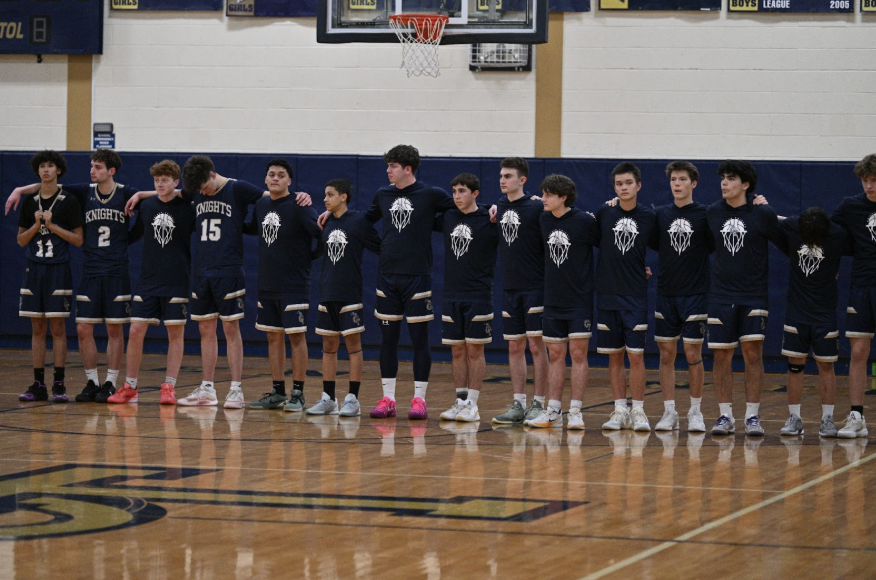
The Old Tappan varsity boys basketball team’s 2025-26 season was defined not by numbers, but by the culture built within the program. Built on strong leadership from both the coaching staff and a veteran senior class, the team embraced a culture of accountability, trust, and togetherness. That chemistry became the driving force behind a group that continued to grow, support one another, and battle through every challenge this season presented.
This growing emphasis on leadership was especially evident among the team’s seniors. Seniors Joey Martin and Issac Shrager transitioned into key leadership roles, helping define the team’s standards as the program develops. Martin said, “I thought we just needed to continue to work together as a team, to get through our season.” For Martin, growth wasn’t always about wins; it was about resilience. After tough losses, he found a way to keep his focus on the next steps: “I stayed motivated by focusing on the next game and not looking back on past losses.” This mentality helped shape a team that no longer dwelled on mistakes but instead used them as motivation to work harder.
Similarly, Shrager, who reached the milestone of 1,000 career points this season, understood the importance of both individual achievement and team reliance. “It was a big accomplishment for me, and it was a goal ever since I came into high school,” Issac said. While the milestone highlighted Issac’s scoring ability, he was quick to credit those around him. “I thought [my teammates] were super important, if not probably the most important thing,” Shrager said when speaking about his 1,000 point milestone. “[They] helped me get through the tough times and helped me succeed.”
Coach Craig Ferraro saw that mindset extending beyond individual moments on the court. He said, “This team had a really strong bond and really enjoyed being around each other.” Ferraro also added, “Basketball season is a grind, and we spent a lot of time together in the gym, and it was a lot of fun to be around this group, because of how well they got along with one another. I thought that type of bond was going to be beneficial to any team, and it definitely helped us this season.” That chemistry wasn’t just visible from the sidelines but was felt by the players themselves, including those stepping into new levels of leadership.
Much of the team’s heart began with the coach. Senior Luke Behrens described Ferraro’s impact clearly: “It didn’t matter if I was missing shots or not playing well, he was always going to support me and have confidence in me to make the right play next time.”
Behrens agreed that leadership was the biggest difference in this year’s team. “We had stronger leadership compared to previous seasons, and that really helped our team,” he said. He also acknowledged a personal challenge: “Sometimes I wasn’t as confident as I should have been in my abilities, but through the support I received from all my teammates and coaches, I was able to reach the level of confidence I needed.”
The impact of senior leadership was clear to underclassmen players as well. Sophomore Jake Totten, who earned a starting varsity role this year, highlighted the support he received from the team and coaches around him. “My coaches helped me a lot, and they were very supportive,” Totten said, “and Joey Martin, Issac Shrager, Luke Behrens, and Bryan Slater were always there for me and always helped me along the way to becoming the best player I could be.”
Totten didn’t view himself as carrying extra pressure due to being an underclassman on varsity. Instead, he believed the responsibility shifted toward those with more experience. “I thought there was more pressure on the seniors because they had to step up into the leadership role and support me in my position.” That understanding between the younger players and seniors reflected the support system this team created.
Junior Carmine Porcelli also felt a shift in his role this season, stepping into a larger presence on and off the court. “This season has been different for me because I felt like I had a bigger role in the team’s success,” he said. “The whole team really focused on winning each game and improving in any chance we could.” Porcelli believed the team’s closeness was a defining factor in their success. “We all picked each other up, no matter what. And even after bad games, everyone was always helping each other get through that tough mindset after a loss.”
That same commitment to teamwork and leadership carried over into standout performances on the court. Junior David Brennan, who also reached the 1,000 point milestone this season, delivered one of the season’s biggest moments by individually scoring 35 points in a win over Northern Valley Demarest. “When everyone had energy, people were just able to feed off each other’s energy, and I felt like it just gave a good, positive vibe in the gym, which translated to good performance on the court,” Brennan said.
This team’s mindset matured significantly compared to past years thanks to the balance of talent, sportsmanship, and support. Instead of allowing doubt to linger after difficult games, the team leaned into persistence. Behrens described it best: “We started off the season very strong and then towards the middle we weren’t doing as good, but we still continued to work hard. I felt like that extra drive helped us pick back up our momentum.”
This same resilience was then shown on Senior Night, when Old Tappan defeated Pascack Valley by 30 points after previously losing to them by just two points on PV’s Senior Night earlier that season. The dominant win not only showed how the team had grown, but also symbolized their ability to learn from their losses and respond with determination.
From a 9–17 season just three years ago to a team defined by resilience and unity, the boys basketball team’s growth was undeniable. The record reflected steady progress, but the bigger shift came in the team’s mindset and maturity. Practices were more competitive, communication was stronger, and players embraced clearly defined roles. When challenges arose, they didn’t falter—they adjusted. And that response, more than any statistic, came to define that year’s Old Tappan boys basketball team.